

Specialist home care marketing agency, Bridgehead Communications, has released the second report in their 2024 edition of the hotly anticipated social media power list, ranking the UK’s leading mid-size care home groups and their individual homes based on their social media following.
The PR consultancy first launched their now annual survey last year with the publication of three reports ranking the UK’s top 20 small, mid-size and large care home groups respectively by their social media following.
Using carehome.co.uk’s list of the Top 20 Mid-size Care Groups of 2024, the report, titled: ‘Social Media Power List 2024 - Top 20 Mid-size Care Home Groups’, ranks each care home group and their respective care homes according to their social media following on the five most widely used platforms in the sector: Facebook, LinkedIn, Instagram, X (Twitter), and TikTok.
The original report, published in August this year, was compiled using follower data recorded in July 2024, but the recorded followings of each ‘group’ or ‘brand’ account have been updated for Care Home Professional in December
As with their previous power list series of 2023, the study also investigates the applications of social media in the adult social care sector. It explores the most effective social media platforms to use depending on the care group’s digital marketing objectives. It also highlights the importance of considering multiple factors in social media to boost engagement, and that striking a balance between group and individual home accounts is the most effective way of reaching a target digital audience.
Care Groups and Homes Combined
In terms of the combined social media followings of each of the care groups and their individual homes, Carebase topped the charts, with 41,060 followers spread across Facebook, X (Twitter), LinkedIn and Instagram. Their X following, at 19,700, accounted for approximately half of this total and was the highest of all groups, in fact constituting nearly two-thirds of the combined total of the top twenty on the platform.

Despite this, it appears that Carebase no longer uses their accounts on the platform. Carebase’s social media following stood around 9,000 followers higher than the second ranked care home group, Berkley Care Group.
Compared to its peers, Berkley Care Group had the most significant Facebook following, which came from a combination of group and individual home accounts. Commenting on the findings of the report, Berkley Care Group’s sales and marketing director, Kat Clayton, said that Facebook has proven a “great tool for highlighting the unique, luxury experience we offer to our residents”. The platform, she continued, also offers an opportunity to “share moments of joy and celebration” in homes, as well as “sharing the stories and celebrating the achievements of our fantastic staff team”.
On LinkedIn, it was Oakland Care who boasted the highest following (10,500), closely followed by Signature Senior Lifestyle, who had just over 9,900. In both cases, these followers came from group-specific accounts. On Instagram, Future Care Group dominated with 16,800 followers, providing approximately half of the total of all the top twenty groups combined.
As with last year’s report,Facebook accounted for the largest proportion of followers (55 per cent – 158,400) among the care groups and their homes. LinkedIn accounted for 21 per cent (62,000), a nine-percentage point increase compared to its proportion of followers among care homes in Bridgehead’s 2023 investigation into the Top 20 Mid-size Care Groups of 2022. X accounted for 12 per cent, Instagram for 11 per cent, and TikTok for less than one per cent.

Individual Care Homes
The analysis also compared the social media following of the individual homes belonging to the top twenty groups.
Cumnor Hill House, which is part of the Berkley Care Group, topped charts for the second year in a row, with its total following (X) coming exclusively from Facebook.Following behind 4,300 followers came Carewise Homes’ Dryclough Manor, who’s following also came exclusively from Facebook.

Top 25 followed care homes
Bridge House Care Home, part of the Carebase group, ranked in fourth place with 3,230 followers. It reflected a more diverse use of social media platforms compared with those in first, second and third – its following divided across three platforms: Facebook, X, and Instagram.
Facebook accounted for approximately 80 per cent of the combined following of all individual care home groups within the analysis.
Individual Care Groups
Lastly, the report ranked each care group by the social media following of their group (or brand) accounts.
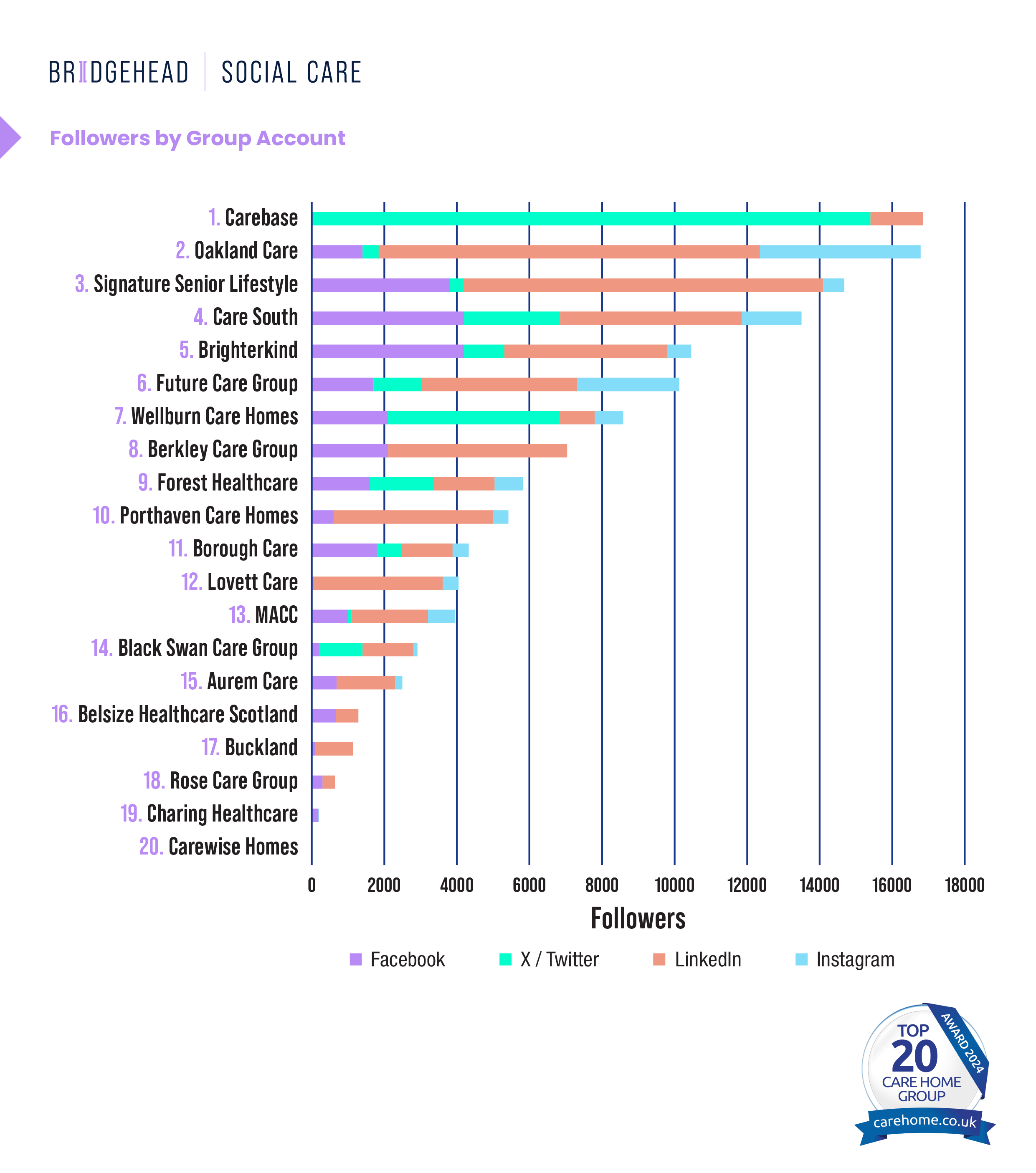
On group-specific accounts, LinkedIn proved the most-used platform, with its tally (59,700) providing nearly half of the combined total of the top twenty groups (130,200). Facebook (26,700), X (29,800) and Instagram (14,000) also proved popular.
As a result of their significant X following, Carebase topped the group-specific account leaderboards with 16,850 followers. Virtually tied, though, and likely to exceed Carebase’s count by the New Year, came Oakland Care, whose 16,780 followers were spread more evenly across social media platforms. Its LinkedIn following (10,500) proved most prominent, though both Instagram (4,400) and Facebook (1,400) followings provided a relatively significant part of their total.
Commenting on the analysis, William Walter, the report’s author and managing director of Bridgehead Communications, said:
“It is a pleasure to launch the second report in this year’s series of social media power list insights. Launched last year, the power lists proved incredibly popular across the sector, offering marketing teams insights with which to inform their digital marketing strategy.
“These investigations offer fascinating insight into how care groups are using these platforms to grow their industry and public presence, with knock-on effects on occupancy rates, reputation, and staff recruitment and retention.
“Our report also considers the advantages and drawbacks of group-specific social media accounts versus accounts for individual homes and explores how your group can strike the right balance.
“Given the larger presence of mid-sized groups on social media versus the smaller groups assessed in our previous report, the findings also offer an interesting demonstration of how social media use in social care is changing over time. The growing prominence of LinkedIn, for example, is an intriguing development. “We’d encourage anyone to get in touch if they’d like to discuss the findings in more detail. We’d also be happy to offer a complimentary virtual or in-person teach-in to discuss how care groups can optimise their social media outreach.”
